3 New Year Lessons I Wish Someone Told Me When I Was 30.
|
I used to think something was wrong with me.
I'd set a goal.
I'd feel inspired.
I'd make a plan.
And then somewhere between Day 7 and Day 21, I'd fall off.
Miss a workout.
Skip a meditation.
Eat the cookie.
Ghost the vision.
And then came the familiar spiral: | "Why can't I just be consistent?"
"Other people seem to have more discipline than I do."
"Maybe I'm just wired wrong." |
|
|
Here's what I didn't realize at the time:
The problem wasn't my discipline. It was my mental framework.
After 22 years of studying human behavior, I discovered three distinctions that quietly change everything about how goals actually work.
Not hustle hacks. Not productivity tricks. Not morning routines with ice baths and lion's mane.
Just three simple shifts in how you relate to growth.
So, as we step into 2026, I want to share three distinctions that completely changed how I approach goals, growth, and becoming who we're meant to be.
Once you see them, you can't unsee them. |
|
|
Distinction #1: Baseline vs. Peak
|
(Why your best days are sabotaging your life)
Here's the first mistake almost everyone makes with goals: They design for their best days instead of their baseline.
Most goals are set during moments of peak motivation: New Year's Eve
After a powerful event
Right after a bad week when you swear, "never again."
So you write goals that require peak performance: |
"I'll work out six days a week."
"I'll wake up at 5 a.m. every day."
"I'll meditate for an hour every morning." |
And then… life shows up.
Stress. Travel. Kids. Exhaustion.
The peak fades.
When that happens, peak-based goals don't inspire us; they shame us. |
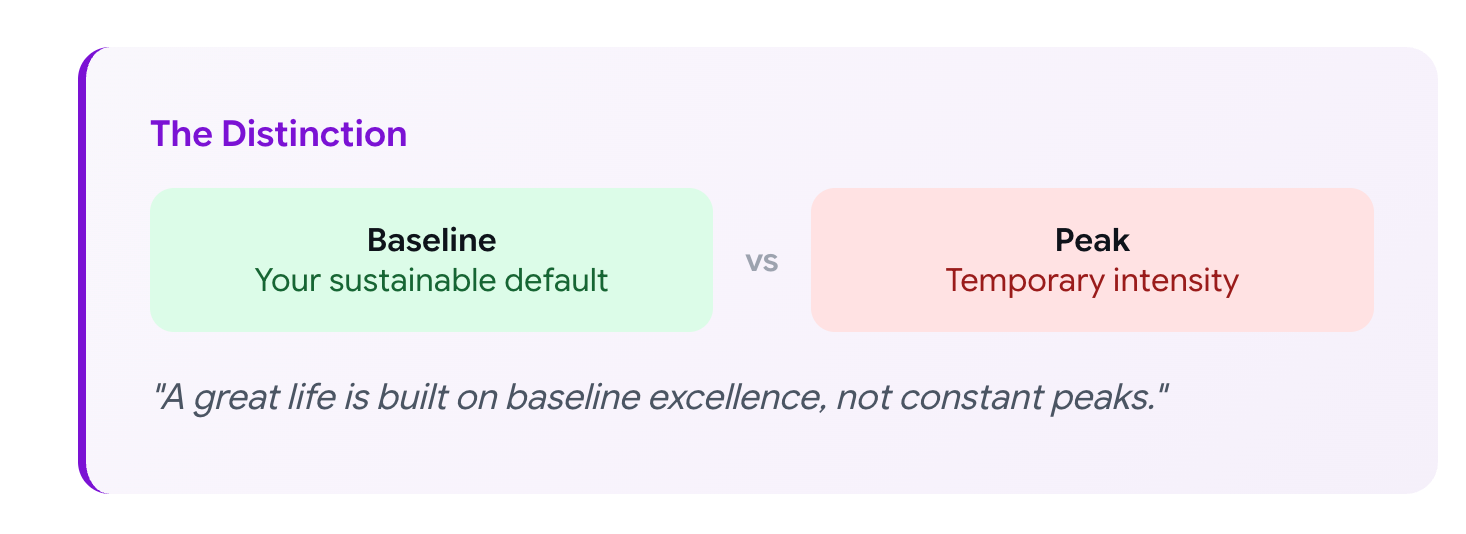
The solution is to design goals around your baseline: your sustainable default.
Not the life you can maintain when everything is perfect, but the life you can maintain when things are hard. |
|
| Years ago, I set a goal to meditate for one hour every morning.
On my best days, I did it. On most days? Zero minutes. Why? Because if I couldn't do the full hour, my mind said, "Why bother?"
When I shifted to baseline thinking, I changed my goal to 15 minutes a day.
15 minutes was non-negotiable. On good days, I did more. On terrible days, I still did at least 15 mins.
And something surprising happened. |
The Lesson: Lowering your minimum actually raises your average.
|
When your baseline holds, you never "fall off." You never restart. And consistency compounds. |
|
|
Distinction #2: Direction vs. Perfection
|
(Why clarity beats certainty every time)
The second distinction explains why so many brilliant people feel stuck.
They believe they need perfect clarity before they can start.
The perfect career.
The perfect partner.
The perfect plan.
But here's what Lifebook taught me: Clarity doesn't come from thinking.
It comes from moving.
Perfection feels productive, but it's actually paralyzing. Perfection says: |
- "Figure everything out first."
- "Make the perfect plan."
- "Don't move until you're sure."
|
Direction says something very different: |
- "This way."
- "Not that way."
- "Let's adjust as we go."
|
When I did Mindvalley's Lifebook program, something was revealed to me: |
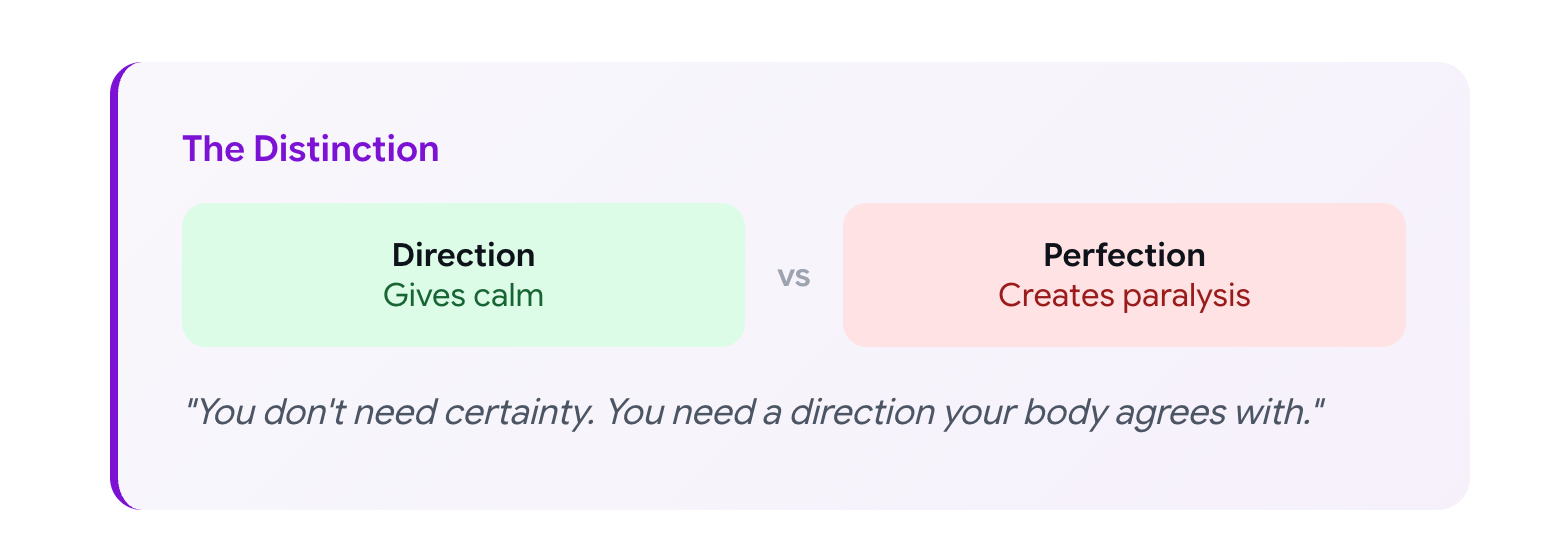
Direction creates calm. Perfection creates anxiety. |
When you know the direction you're heading, even if the details are fuzzy, your nervous system relaxes.
Your body goes: "Okay. We're not lost."
That's why one phrase matters so much here: You don't need certainty.
You need a direction your body agrees with.
Your body knows before your spreadsheet does. |
- Contraction, heaviness, resistance? That's data.
- Grounded, energized, quietly "yes"? Also data
|
Direction is enough. Think of it like driving at night. Your headlights don't show the whole road, just enough to keep moving. And as you move, more of the road appears. |
The Lesson: Don't ask: "What's the perfect destination?" Ask: "Am I generally moving in the right direction?"
|
That's how momentum is born. |
|
|
Distinction #3: Correction vs. Self-Judgment
|
(The difference between mastery and misery)
This may be the most important distinction of all.
Because you will slip.
You will miss days.
You will drift.
The question isn't if that happens.
The question is: what do you do next?
For most of my life, missing a goal triggered self-judgment.
Not data. A verdict.
And here's the irony:
Self-judgment doesn't motivate change. It trains avoidance.
Your nervous system learns: "This pursuit = pain." |
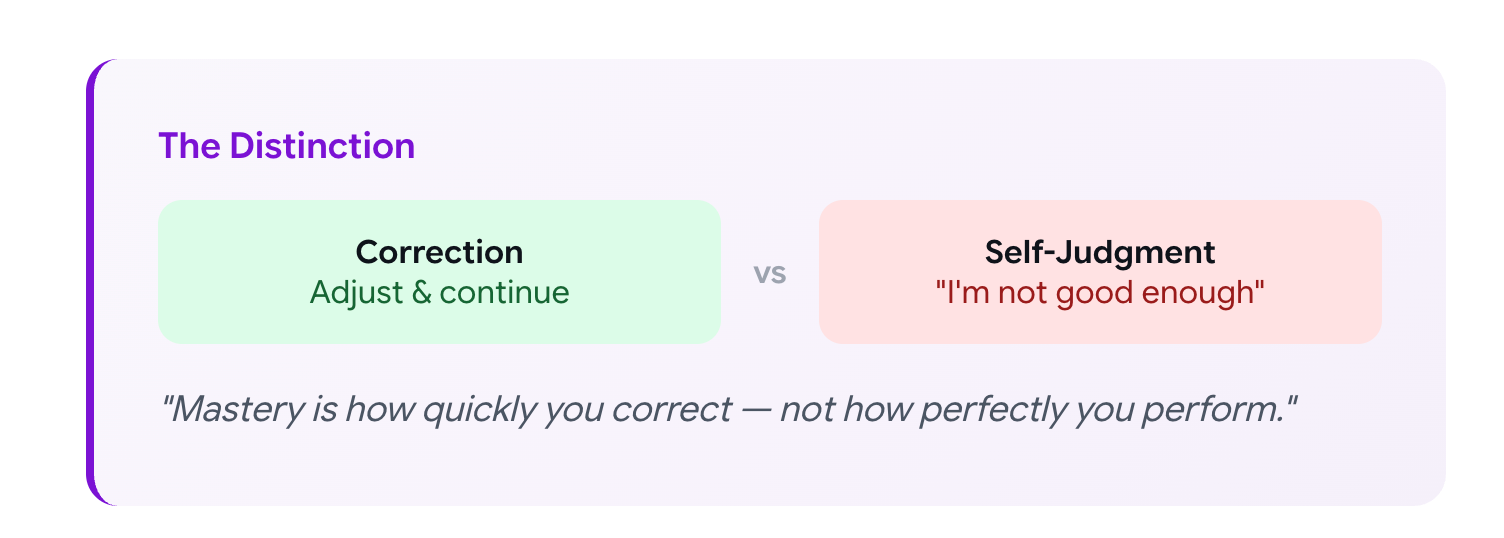
I once heard someone describe mastery as "the rate of correction, not the absence of error." That reframed everything for me.
Masters aren't people who never fail. They're people who fail, notice, adjust, and continue, faster than everyone else. Their secret isn't perfection. It's rapid, shame-free correction.
They're people who: |
- Notice quickly
- Adjust calmly
- Continue without drama
|
Consistency isn't heroic. It's mechanical.
You missed a workout? That's not proof that you're lazy. It's data. What got in the way? What could you adjust? How might you make it easier next time?
You broke your diet? That's not proof that you lack willpower. It's feedback. What was happening emotionally? What need were you trying to meet? How can you meet that need differently?
Correction is clinical. Curious. Kind. It says: "Interesting. Let me adjust and continue."
Self-judgment is emotional. Harsh. Final. It says: "See? I knew I couldn't do this." |
The Lesson: When you fall short, ask: "What can I learn and adjust?" Never ask: "What's wrong with me?"
|
Correction creates momentum.
Judgment creates quicksand. |
|
|
What These Three Distinctions Add Up To
|
Most people don't fail at goals because they lack motivation or intelligence.
They fail because they're using the wrong mental models. |
- They design for peaks instead of baselines
- They demand perfection instead of direction
- They choose judgment instead of correction
|
Shift these three distinctions, and everything changes.
Not through force. But through alignment. |
|
|
So as you step into 2026, here's my New Year's wish for you:
|
Be kinder with your baseline.
Trust direction over certainty.
Correct faster and judge less.
You're not behind. You're not broken.
You were just never taught the real rules of the game.
Happy New Year. Here's to an extraordinary 2026.
A Question for You: If you were to redesign one area of your life, not for peaks, not for perfection, not for judgment, but for: a livable baseline, a direction your body trusts, and fast, gentle correction.
What would change first? Let me know in the comments section of this blog.
That question alone might be the beginning of your next chapter. |
|
|
Your Next Step for 2026 to be the best year yet:
|
If these 3 distinctions landed for you, there's a reason. An Insight creates awareness. But change begins when awareness meets structure.
That's why Jon & Missy Butcher created Lifebook: not as a goal-setting system, but as a way to design your life around a livable baseline, a clear direction, and continuous, judgment-free correction.
If you want 2026 to be different, start the year with clarity, now.
We've extended our current Lifebook Special offer for next 12 hrs, including the Breakthrough Guarantee we shared recently.
If you're ready to turn your reflections into a strong intention for the rest of your life: |
Special offer ends tonight 11:59 PM PST |
|
|
Whatever you choose, remember this: You don't need to become someone new.
You just need a system that supports who you are becoming.
With love, Vishen |
|
|
 Mindvalley Inc, 407 California Avenue,
Suite #2, Palo Alto, CA 94306, United States |
| |
| |



No hay comentarios:
Publicar un comentario